

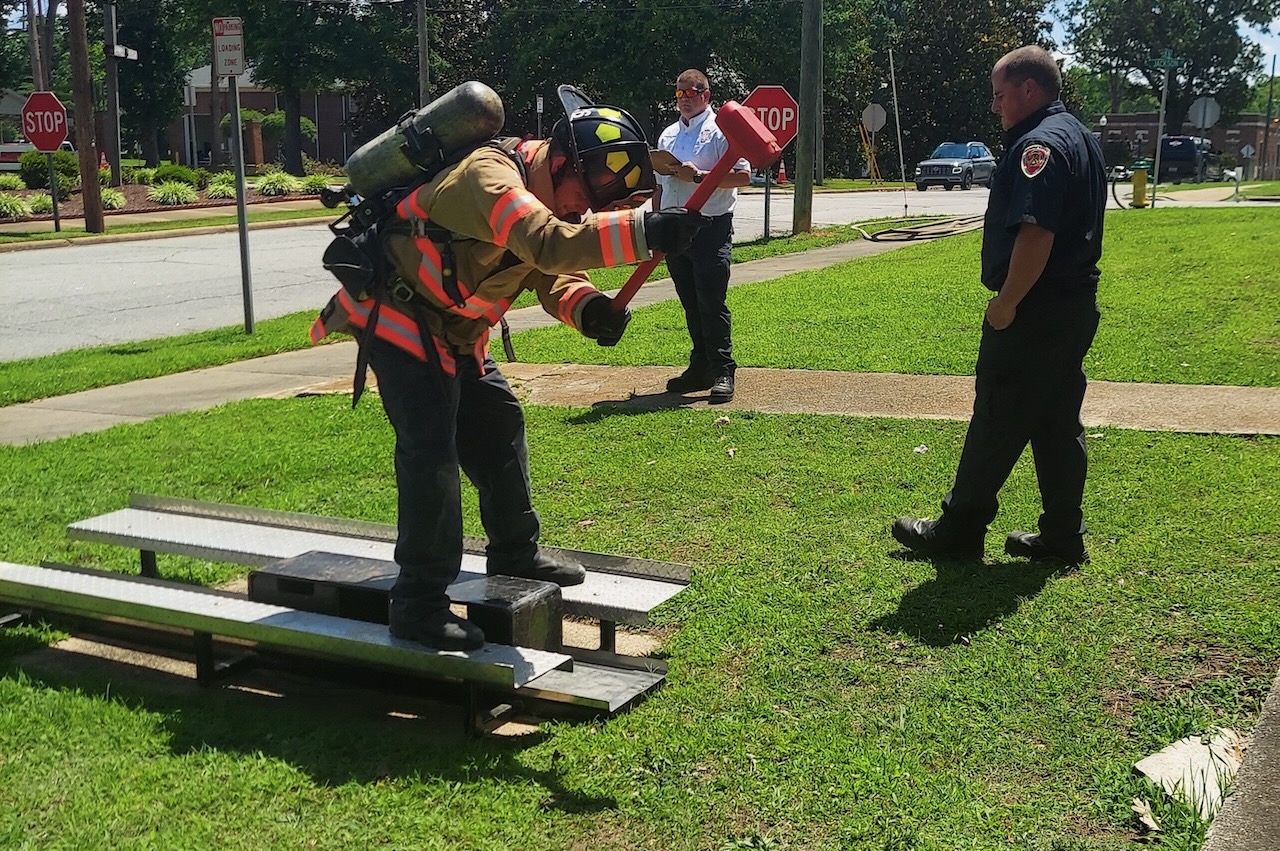
In the late spring swelter this morning, five of seven people who have applied to be part of the Roanoke Rapids Fire Department’s hiring pool went through the agility training to prove themselves worthy when a position becomes available.
One of the applicants who asked their name not be used, wants to come back to the fire department and went through this test about 10 years ago.
Drenched and to the point of exhaustion after climbing to the top rung of the ladder truck, traversing the outside stairs of the Jo Story Senior Center, carrying a mannequin representing a spent firefighter and other physical tasks, the applicant says, compared to the first time he took the test, “It still sucks. You climb the ladder and you blow your legs out. You go over there and you climb the stairs and you blow your legs out and then everything else — you’re just winded.”
The applicants weren’t wearing full gear which would have equated to around 100 to 115 pounds. During the agility test it was closer to between 50 to 75 pounds.
While it’s not fun, he said, the rewards of becoming a firefighter outweigh the physical demands of tests conducted during the humid morning. “These guys definitely sacrifice a bunch of time to give to the community, time away from their families, time away from their hobbies, time from everything else they’ve got going on to show up for 48 hours to protect the city.”
RRFD photos


Mirroring a normal day
The test mirrors what firefighters will endure on a normal day, Chief Jason Patrick said.
The tests are administered usually once or twice a year depending on need, he said. “As far as how many we have in the hiring pool.”
While the fire department is not immediately looking to hire, Patrick said, “We like to have a pool of individuals so if somebody leaves we call and make a job offer.”
And today’s weather is something that comes with the job. “That’s another element,” the chief said. “We can’t predict the weather. All we can do is set it up. We typically try to do it in the fall or spring.”
The factors
Assistant Chief Richard Cook said the fire department looks at several factors in the agility training — the ability to couple or uncouple hoses, remove a ladder from the truck, and carry a ladder. “We’re checking them to make sure they can climb a ladder and make sure they’re not afraid of heights.”
Following the ladder climb they go to an area where they wear an air pack to make sure they’re not claustrophobic and that they can wear it. “We put them in a room and let them feel their way around for about five minutes.”
The last part is the obstacle course, which consists of five timed events, Cook said, with the dummy drag and hose pull being the culminating events.
Simulating real events
All the events in the agility testing simulate real events, said Deputy Chief Wes Hux. “We’ve got climbing stairs and carrying a hose roll which simulates going into Becker Manor or a hotel. Once they get up they hoist a hose roll up by a rope that simulates pulling a line up to a higher floor to get the water up there.”
Then there is the Keiser sled drill which simulates having to chop into a building or roof for ventilation. “It’s just a piece of steel on a sled and they’re hitting it with a hammer. They’ve got to drive it basically from one end of the sled to the other.”
The test has changed since Hux went through it. “We had a six-foot wall we had to hop over and then we went through an obstacle course running along a bench that was like a balance beam,” he said. “Then you had to climb up a 24-foot ladder to the top of the telephone pole and then back down.”
Hux believes the tests then and now were equally tough.
Cook says the testing is a good example of what they will experience. “The fire ground is pretty demanding physically.”