
While several Enfield residents signed up to speak Tuesday, most said they would defer to whatever the town’s mayor, Mondale Robinson, had to say on the Quiet Data Centers Halifax proposal, which is slated to be built just outside the town limits.
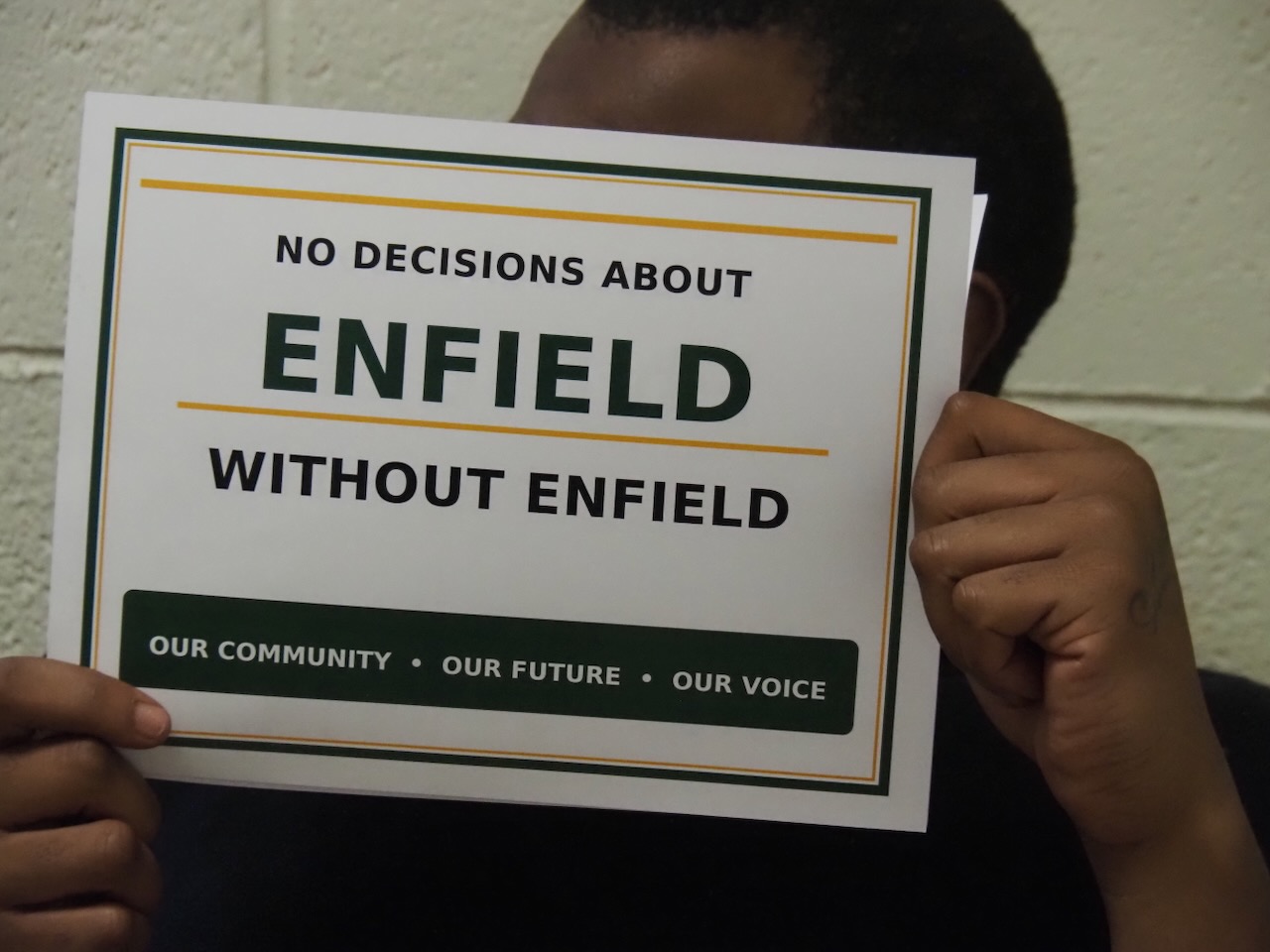
Several held signs that read, “No decisions about Enfield without Enfield.”
During the nearly two-and-a-half-hour information session held by the Halifax County Board of Commissioners, many spoke — a few in favor and others with questions about the AI data center, which the county is expected to close on by September 18.
Referring to a comment made by board Chairman Vernon Bryant that the board didn’t have to hold the meeting due to certain state statutes involving economic development agreements, the mayor said, “When we start this meeting by saying the board didn’t have to do this, you don’t make this an easy path for the board. You don’t make a lot of friends when that is the message that you’re starting off with. The idea that you don’t have to do it turns representative democracy on its head. These people are your bosses.”
Robinson said elected officials need to remember they work for the people “and stop acting like we are in positions of power when our power is directly tied to their vote.”
Because of the three-minute time limit imposed on the speakers, the mayor said, “I hope that you all are preparing to schedule a time with me to come to Enfield without those parameters to talk about what our relationship would look like.”
He said he heard the names of Dominion and Halifax Electric Membership Corporation being bandied about. “I heard about the water storage which is owned by the county. But what I didn’t hear about as a utility is the town of Enfield sewer. Whether you are closed-looped or not, you will have sewer. And according to all of the state material for the super site, Enfield is the sewer provider. So if everybody’s been in this conversation, I’m trying to find out when I became little brother.”
As mayor, Robinson said he wondered why he was excluded and invited QDCH CEO Andy Stahl and Chief Development Officer Brendan Morris to meet: “Let’s talk about what our relationship will look like.”
While he said he wasn’t against the data center, he added, “What I do know is I am against anything that does not include the voice of the people of Enfield. So when we get serious, we can talk about all of the other things that’s available and on the table, but not in this context where I feel like I’m rushed and I have 15 seconds to finish.”


A voice from Roanoke Rapids
Ephraim Brodsky of Roanoke Rapids said he stood with Robinson. “I did a lot of research on Quiet Data Centers, and the quiet stands for the noise that the data center makes — the quiet stands for the data center going on in backroom dealings to get the deals done.”
He said the commissioners should be ashamed “for trying to pull the wool over our eyes. There are people here paying attention. I stand with Mondale Robinson 100 percent. We all should be involved. You’re saying this is bringing a certain amount of money to the county. You are not promising to lower our taxes, but every year county employees get giant raises. The county employees are making more money than anybody else in private industry in the county.”
He said County Manager Dia Denton gets a salary of close to $200,000 a year if fringe benefits are included.
Brodsky also wanted to know about electrical load studies and environmental impact assessments that were required by the contract. “Nobody had them. Our county didn’t have them.”
When Bryant requested that the studies be provided to Brodsky, County Attorney Glynn Rollins said they were not public records “and they’re never going to be. We don’t have them. We’re not entitled to them. That will be between you and the company if they want you to have them.”
He said those are documents that aren’t required under the land purchase contract. “It’s not something that’s required to be given to the county.”
County NAACP comments
Ray Harvey, president of the Halifax County Chapter of the NAACP, wanted to know what the Halifax EMC board looked like, meaning its racial makeup, and also requested the same documents that Brodsky sought. “I heard that most of these data centers are built on our backs — the low-income people. I’m not here to bash anyone and I’m not here against, but I just want to make sure that the people who are most affected by this data center are taken care of.”
Harvey said he believed county residents should have the first opportunity for jobs. “Is the company willing to train these folks so they can get these jobs?”
Another view from Enfield
Sarah Brinker told the board, “If we move forward with this, you know we set a precedent and I think it’s absolutely critical that Halifax County’s standard is above and beyond anybody else. We need to make sure we’re looking out for our county. These guys have plenty of money and we need to be asking for the moon.”
Brinker said she believed there will be impacts. “Making them stand up to the best management practices is not going to be enough. There are going to be impacts and we need to look at ways that they could offset those impacts.”
She said she wanted to know “that we are constantly striving for excellence for technologies as they come out and we don’t get locked in or companies get grandfathered in at a certain standard and then we can’t raise that standard and hold them accountable.”
Brinker said that she wanted “to make sure that, as a county, we really, really set the bar high and we strive for continuous improvement — that we don’t just say we’re poor, we need you, we need the money to come in. But can we do it at a very high standard? We can’t.”