

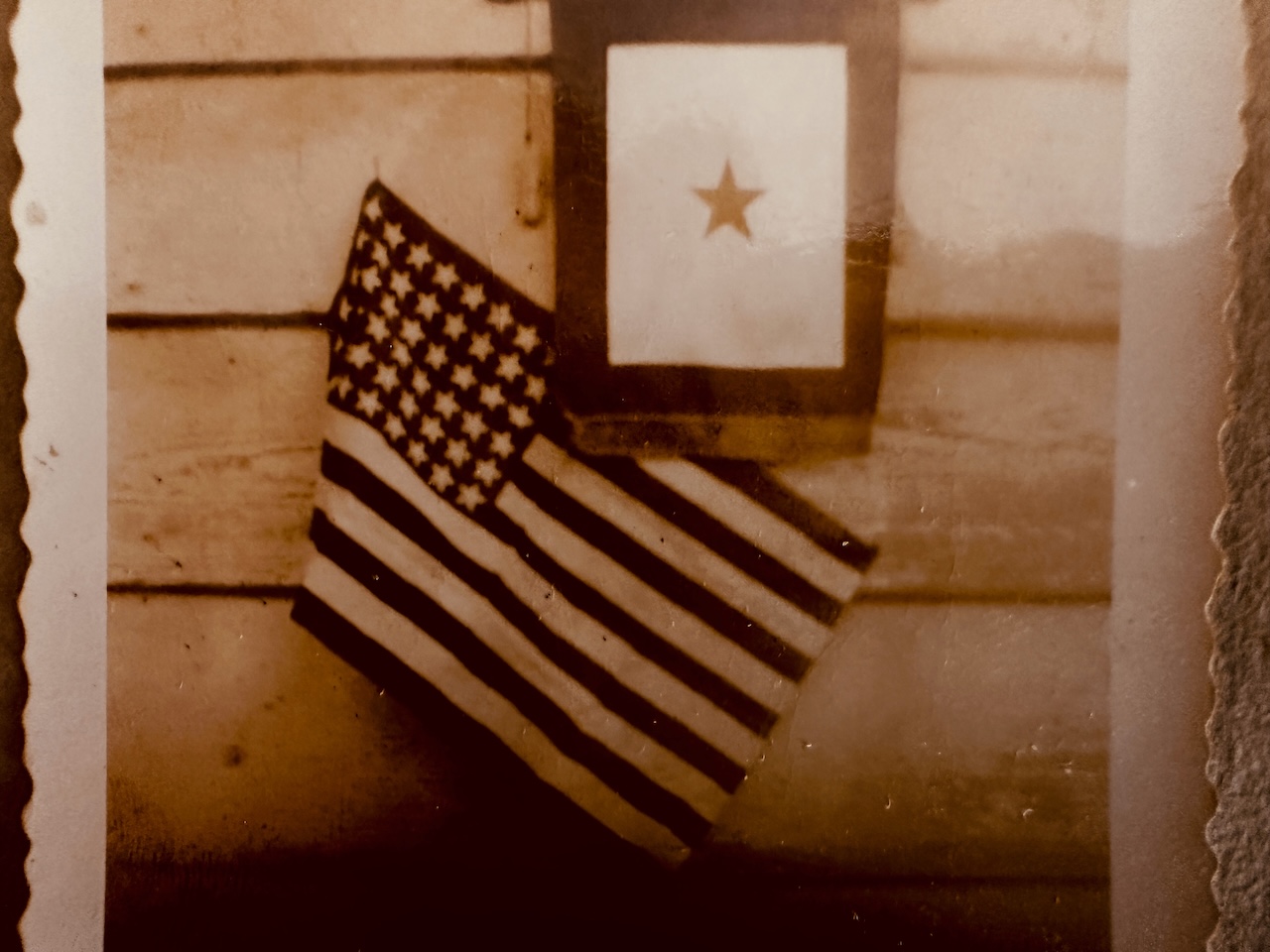
It holds photos of the American homefront while my father served in World War II.
In its fragile pages are scenes from Princeton Farm Road, the town of Severn in the 1940s, and photos of a great-grandfather and other relatives whose names I’ve heard mentioned but never knew.
Its binding gave way years ago, but the strong paper remains intact.
Although some of the photos have loosened, I now look for ways to salvage what has become a priceless piece of local history to me.
It was a gift of love from my grandmother to her son. You can see from one of her notes that he sent it back before departing for England from Iceland, where he was part of the U.S. Army Corps of Engineers and held the job title of heavy equipment operator.
To me, this album is a fitting representation of America in a time of uncertainty because as war raged in Europe, in Northampton County there was farm work to be done, peanuts to be dug, hogs to be slaughtered, and children to be tended to.


My father didn’t live to see the Bicentennial; he died two months and a few short days before July 4, 1976.
It is something I can only imagine he would have loved. Edgar Lee Martin loved history, and I believe our trip that summer would have been tied to the celebrations. After all, among the many books he owned was a bound copy of First for Freedom, a play which tells the story of the signing of the Halifax Resolves.
One summer we fought the Civil War, which included trips to Gettysburg, Appomattox Court House, and Petersburg.
As my father was a Mason who trained others in the craft, we also visited the George Washington Masonic National Memorial in Alexandria.
I can only imagine that in the summer of 1976 he might have decided that we should revisit New Bern, perhaps go to Charleston, South Carolina, revisit Williamsburg, or just take in a performance of First for Freedom in Halifax.
There were so many trips where history figured highly — Bath, Jamestown, and The Lost Colony performance come quickly to mind.
That’s always been my biggest regret: that a man who so loved and revered history died without being able to witness the 200th anniversary of this nation.
It’s unlikely he would have been alive for the 250th since he was born in 1918, but I can only imagine the thrill he would have experienced seeing the original Halifax Resolves returned to where they were signed, and speaking with fellow Masons at the lodge in Halifax.
That’s all speculation, and if I think about it too much it makes me sad.
I can’t say what his thoughts about our country’s current situation would be, as politics — at least in front of me — were rarely discussed in the house.
I only know that both my parents were registered Democrats and my mom, who is 99 now, voted in the 2024 election.
But as much as politics figure into this year’s 250th celebrations, I’ll steer clear of prodding and poking, even though I am my father’s son and take after him in many ways, including that trait.
What I am certain of is that he would have loved to have been a part of the Bicentennial, and I’m sure he would have been involved through the lodge or by taking his family on a time-capsule trip through history.
I think that’s why this photo album means so much to me — because this man not only loved history, he was also a part of this country’s and this world’s history.
I think my grandmother, whom I only briefly knew, was aware of this and wanted this to serve as an American snapshot of life in rural Northampton County as my father joined a fight to ensure this country would celebrate not only a 200th anniversary, but a 250th — Lance Martin