

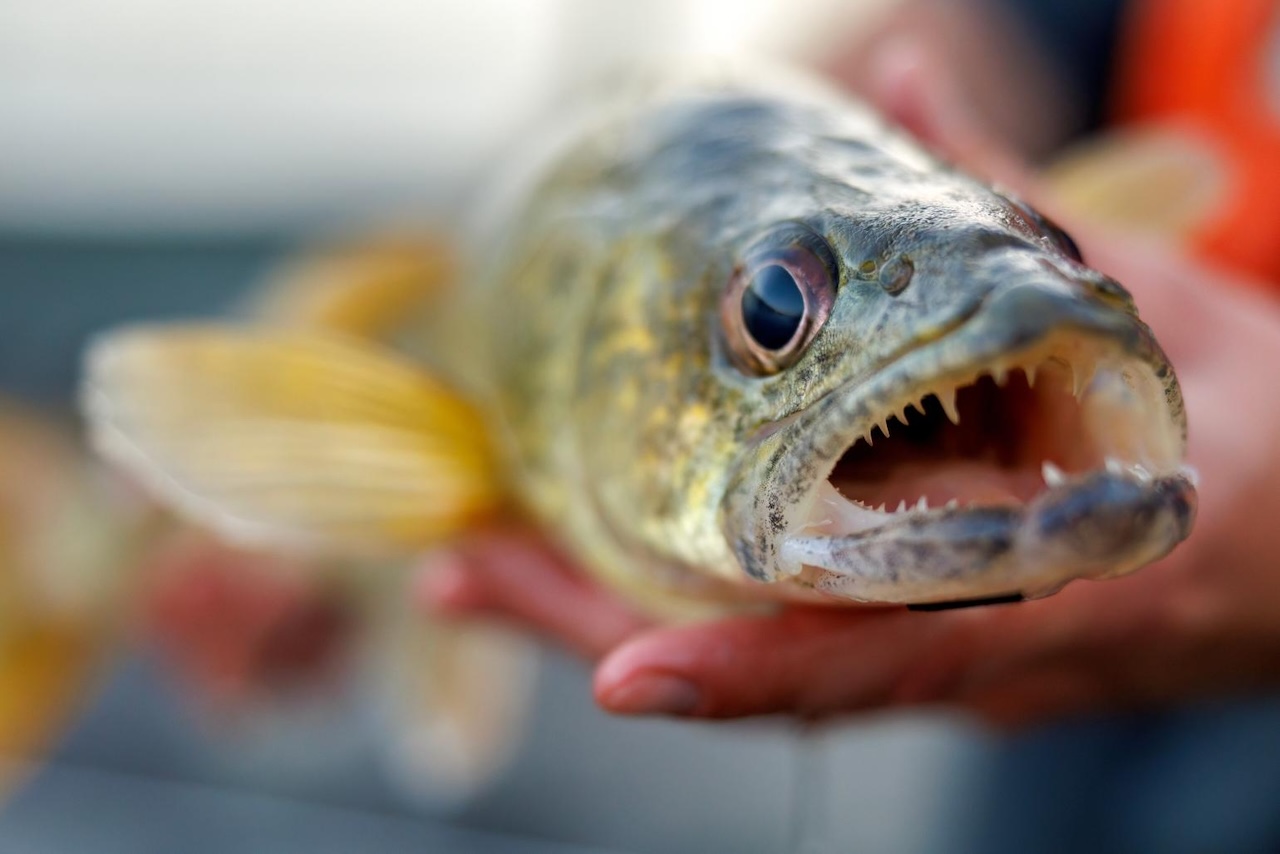
If you’ve ever been fishing or walking along the shoreline of Lake Gaston at night and shone a flashlight in the water, you may have seen glowing eyes staring back at you.
Good chance it was a walleye.
It’s a cool-water, popular sportfish native to the western part of North Carolina and typically targeted for their excellent table fare.
It’s one of this species’ coolest features besides their toothy grins.
That glowing appearance is caused by a reflective sheath in their eye called a tapetum lucidum. This special tissue, coupled with their large eyes, helps them see better in the dark or more turbid waters.
This is why they are most active at dawn and dusk and go to deeper water when the sun is high. This is also why biologists often electrofish for walleye at night using spotlights to see their eyes in the dark.
Young walleye are stocked intermittently into Lake Gaston by the Virginia Department of Wildlife Resources to provide unique angling opportunities for the public.


Walleye can successfully spawn and reproduce in Lake Gaston, creating a self-sustaining, robust population that all anglers can enjoy.
In addition to having distinct diel movement patterns (or movement based on the time of day and amount of light), walleye also have seasonal movement patterns throughout the lake.
In Lake Gaston, walleye are common in the tailrace of Kerr Dam (i.e., the water flowing out of the Kerr Dam and into the upper riverine area of Lake Gaston) during March and April when they move upriver to spawn.
As spring progresses into summer, the water in the tailrace remains cold, but one essential water quality parameter decreases dramatically – oxygen.
This is because Kerr Lake becomes stratified in the summer (meaning there is little to no oxygen at the bottom of the lake).
As the Kerr Dam releases this bottom water into the tailrace, a large portion of the upper end of Lake Gaston becomes hypoxic (i.e., has very little oxygen).
This means that after spawning, walleye use the riverine habitat downstream of the tailrace until the dissolved oxygen in the water declines, at which point they disperse throughout the lake. However, after they disperse, little is known about their habitat and distribution throughout Lake Gaston.
The North Carolina Wildlife Resources Commission fisheries biologists have initiated a telemetry study to learn more about the movements of walleye in Lake Gaston. In March 2026 biologists anesthetized fish and surgically inserted acoustic transmitters into 50 walleyes.
These internal tags produce underwater signals, or “pings” which are detected in real-time on underwater receivers located throughout the lake.
As a tagged walleye swims by a receiver, it records the temperature and depth of that fish. Biologists are then able to extract the receivers and download data for analysis.
Results from this project will help inform anglers on where to target walleye during specific times of the year, including what depths or temperatures to target.
Results will also provide insight into the spawning dynamics of male versus female walleye to help biologists better predict the timing of spawning based on environmental cues and inform fisheries management decisions across the state.
How can you help? All tagged walleye have yellow anchor tags just under their dorsal fin that includes contact information.
If you catch a tagged one, please release the fish back into the lake so it can continue logging data for the project. Before releasing, take note of the fish number on the yellow tag.
You can then call the telephone number on the tag to let biologists know when and where you caught the fish. This will provide additional information for the project and help biologists better understand the ultimate fate of that fish.
David Belkoski is the inland fisheries biologist for the North Carolina Wildlife Resources Commission