
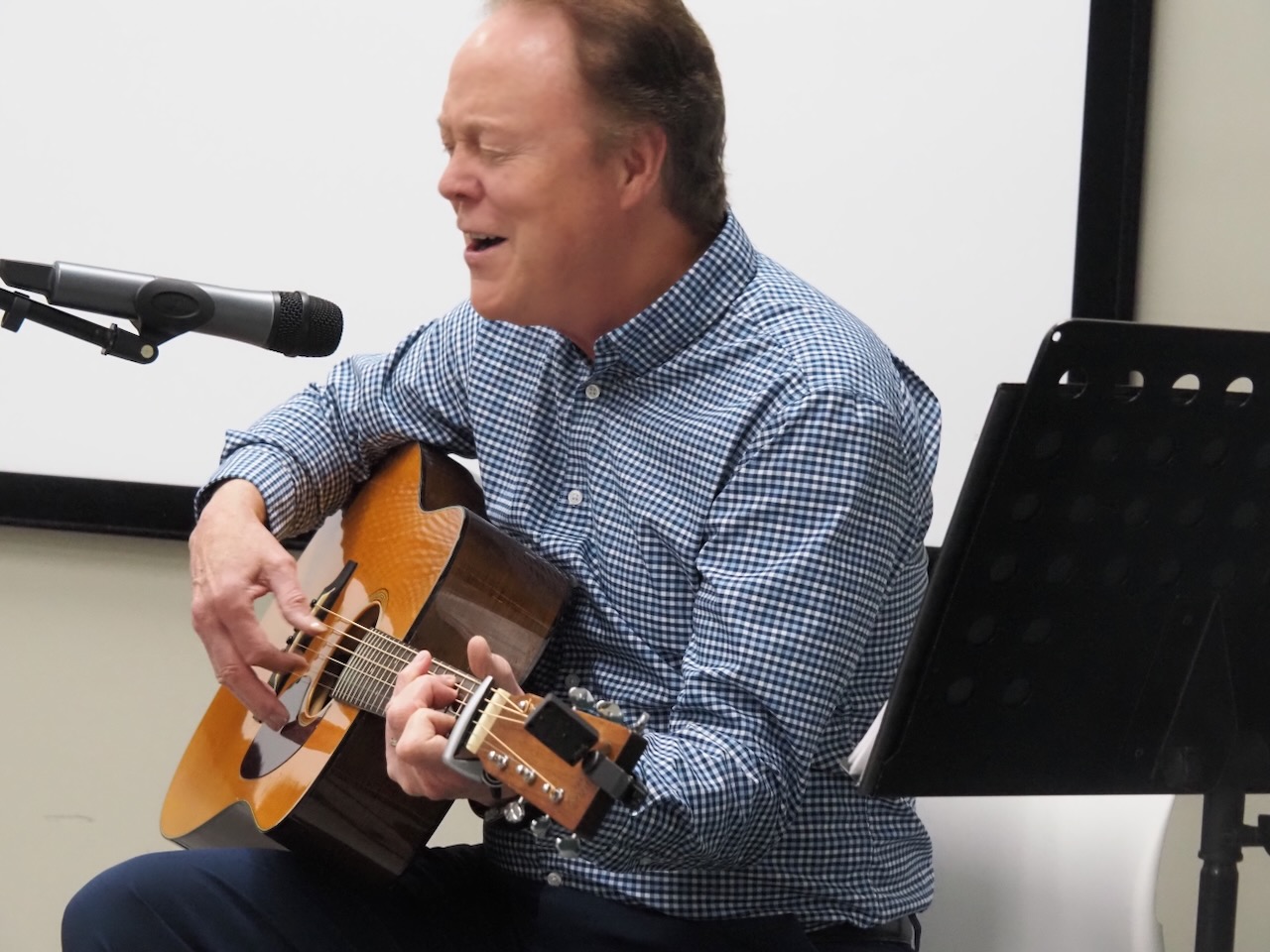
In an atmosphere that was more chautauqua than concert, retired WRAL anchor Bill Leslie sang about growing up in North Carolina, read from his book Blue Ridge Reunion, and shared his experiences to a small audience at the Center for Energy Education Thursday night.
Now seven years into retirement, Leslie said in an interview before the show, “I miss the people. I don’t miss getting up at 2:30 in the morning. That’s what it took to get in there and be ready for a 4:30 broadcast.”
Including his time in radio, Leslie spent 39 years with WRAL.
He describes himself as the first full-time environmental reporter in the Southeast when discussing the most impactful issues he covered. “We did some investigative reporting, lots of documentaries. We uncovered a lot of problems that people didn’t know about, and we won some major awards as a result of that.”
More important than the awards were some corrective actions taken in the legislature to help better protect the water quality of the Neuse River. “I think more than anything else, it alerted the public to the problems that we have.”


When he talks about role models in the business, he notes Walter Cronkite and fellow North Carolina native Charles Kuralt. “I had the opportunity to spend a day with Walter Cronkite, which was awesome, and I spent the day with Charles Kuralt. Those are two of my heroes.”
The state has been the birthplace of several famous journalists, including David Brinkley and Edward R. Murrow.
What it is about the state and journalism, he can’t say. “I don’t know. It just does seem to be a breeding ground for some pretty good journalists.”
Kuralt, Leslie said, was a terrific writer who started in newspapers and then went into broadcasting.
Kuralt was noted for his On the Road segments on CBS. “You could always tell that he was in love with language, the rhythm of language. Every story was a masterpiece.”
When Leslie started, the formula was fairly simple, he said. “You covered the news. There were always two sides to a controversial story. We always covered one side and the other because if you didn’t, the FCC would come and hammer you and take your license away.”
He believes there are still many good journalists working today. “But I also think there are a lot of people who are not really good journalists and they kind of taint the pool a little bit.”
Talking with his former co-anchor Renee Chou, he said she described COVID coverage as that of covering a hurricane — “a new hurricane every day. It was just so intense.”
Leslie has been amazed by the technological leaps in the field, and WRAL has kept up with the trends. “WRAL was the first in everything it seemed — the first to get a team of meteorologists, the first to have a helicopter to cover the news. Then you get into the drones and these backpacks that you take anywhere in the world and do a live report. It’s just amazing.”
When discussing his favorite interviews, he recalls talking with the late Billy Graham at his home in Montreat. “That was fantastic. I had tried and tried and tried to get that interview for several years and he finally agreed.”
There was a small group of journalists who were invited and went to his cabin for the session. “It was wonderful. He was such a warm, dear person.”
Then there was First Lady Barbara Bush, whom he interviewed at the GOP convention in Houston. “Barbara Bush, I thought was a fabulous interview.”
He described her as a firecracker during his performance.
And the one person he always wanted to interview but never got the chance? Andy Griffith. “He would not. He was very private, and finally he told his PR guy to tell that Leslie guy to leave me alone.”
Bill Friday, former UNC president, was also a favorite interview. “He was one of the nicest, smartest, kindest, most personable people I can imagine. He was fantastic.”
Music has always been part of Leslie’s life. “When I was in high school, I was playing with a couple of groups. We actually recorded a song and it got airplay on the radio station.”
He said it was a song about his girlfriend Missy. “It was pretty awful, but it was kind of catchy.”
These days his music inspiration comes from a group called Nightnoise — a band which is no longer together and was one of the original lineups in the Windham Hill stable.
“I went to see them in Charlotte and they played the violin, piano, acoustic guitar, flute, and Celtic whistles. There were tears streaming down my face. I’ve always heard that if you catch yourself crying unexpectedly, you need to pay attention to that.”