
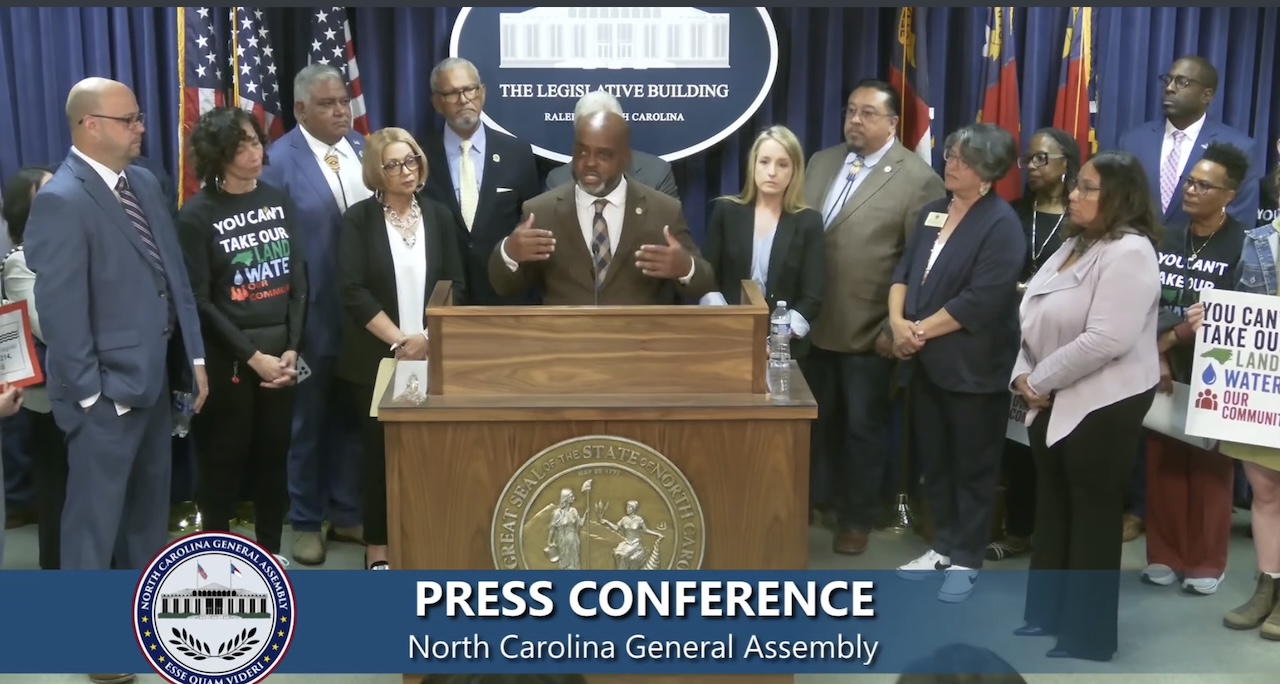
The controversial section of a proposed Senate bill that would allow Franklin County to condemn property in three neighboring counties is not just about infrastructure — it’s about land, House District 27 Representative Rodney Pierce said during a press conference at the Legislative Building in Raleigh today.
Senate Bill 214 was pulled from the House Calendar today, but the Senate is expected to discuss the matter at 4 p.m.
Representatives from the three counties that Section V, Part 5 of the proposed legislation would affect — Halifax, Vance, and Warren — stood with Pierce and spoke during the conference.
“I am adamantly and unequivocally opposed to it,” he said. “This should not be a partisan issue — whether you are a Democrat, Republican, or unaffiliated. The idea that one county can take property in another county without consent should concern you. That principle goes beyond party. It speaks to fairness, local control, and respect for our communities.”
He said, however, that the provision is being pushed by the Republican majority. “Even so — wrong is wrong no matter who advances it.”
Pierce said during the debate on the matter last week, “We were told that this provision is about water resources. But when you read Section V, the language is vague — far too vague. It does not limit itself toward infrastructure. It uses the term property and that opens the door far more than what was described on the floor. That means land. That means facilities. That means assets that communities rely on. That’s not policymaking. That’s writing a blank check.”
The process that led to the debate is concerning as well, Pierce said. The proposed bill started as a local bill in February 2025 and because of that, it can’t be vetoed by the governor. It passed the Senate in March. In June, it became a committee substitute in the House, meaning it could no longer be amended. It passed the House in July but failed in the Senate in September.
Conference committees were formed in October and then this April “the conference report suddenly became public” and was placed on the calendar for a vote on April 22 — the following day. “There was no meaningful opportunity for amendment, no real opportunity for public input at that stage — just a fast track to final passage. That process should concern anyone who values transparency and good governance.”
The counties affected by the contentious portion of the proposal are all Tier 1 counties, which are among the most economically distressed. “They are majority-minority counties with deep, complex histories,” he said.
The voices and rights of these counties matter, Pierce said. “Opposition to Section V is not isolated. It is widespread. Resolutions opposing this provision have come from Halifax, Vance, Warren, and Granville counties. The Haliwa-Saponi Tribal Council has adopted one, as has the Roanoke Rapids Sanitary District. Municipalities, business leaders, and economic development organizations across the region have joined in opposition.”
Water, Pierce said, is a shared resource. “Managing it requires cooperation, trust, and regional partnerships — not unilateral authority to take from your neighbor. Section V is undemocratic. It goes against the principle of being a good neighbor, and it undermines the very idea of cooperative regional governance. I oppose it. The people of House District 27 oppose it, and I believe millions of North Carolinians oppose it as well. The language should be removed completely and it should never be reconsidered under any circumstances.”
Granville County concerns
House District 32 Representative Bryan Cohn, who represents Granville County and parts of Vance, said his district represents all of the Kerr Lake shoreline in North Carolina. “I’m here today because the people of Granville, Vance, Warren, Halifax, and all surrounding communities and municipalities are deeply impacted by the 35 words that were presented in SB 214.”
He said “the sovereignty of our communities is extremely important. The right to self-govern, the right for you and me as individual citizens to be able to elect our leaders and shape the future and progress of our own respective communities is a longstanding tradition started in Halifax County.”
Cohn said “we cannot, obviously, have governments reach across borders and take our property or condemn property. These are things that need to be negotiated. This is unprecedented in North Carolina. This is a unilateral grab for land.”
Henderson mayor
Henderson Mayor Melissa Elliott said the matter is simply not a bill. “This is an environmental justice fight. This is a local control fight and this is a moral fight. Vance, Warren, and Halifax are not just dots on the map; these are people, these are families, these are communities with dignity, and I rise to say do not place another burden on the backs of people already carrying too much.”
Democracy, Elliott said, “Is supposed to operate in the daylight.”
Attorney’s viewpoint
Melissa Dixon, a Roanoke Rapids real estate attorney who also serves as counsel for the Roanoke Rapids Sanitary District, said, “Transparency is key. It is everything. This attempt by Franklin County to use a local bill to allow it to take land from neighboring counties without following normal statutory procedures is illegal, is immoral, and it is unconscionable.”
Dixon said the proposal would allow the condemnation of land across county lines without any guardrails or meaningful limitations. “And this is clearly illegal. Make no mistake — we will not be bullied by Franklin County into giving up our land and water no matter how rich they get.”
Dixon used the term “too big for your britches” in discussing the matter. “And respectfully, I would suggest that if Franklin County is getting too big for its britches, it needs to find a way to work with other local governments and get it done the right way.”
People who are trying to protect their property and hold onto inherited farmlands and heir properties are concerned whether their property is safe. “Sadly, I don’t have an answer for them. That kind of legal uncertainty has consequences. It affects community growth, business infrastructure, investments, and voter trust in the systems meant to protect them.”
Haliwa-Saponi Tribe
Earl Evans, vice-chair of the Haliwa-Saponi Tribe, said, “What is most disappointing is that something like this would occur without a county or municipality consulting with a tribal nation who is your neighbor. We consider ourselves to be friends and neighbors to all of the other public governments that surround us.”
Halifax County Board of Commissioners
Vernon Bryant, chair of the Halifax County Board of Commissioners, said, “I want to state emphatically that Halifax County requests the removal of Part 5, Section V of Senate Bill 214. While we understand that Franklin County has specific needs, especially in water to meet future demands, and given that we support intergovernmental cooperation partnership, we cannot stand by while our critical resources of land and water are threatened by legislation that has no means of collaboration or transparency.”
Land and water are some of the greatest assets in the county, he said. “The fact that another county would want to legislate and take away those resources without consent is a problem. That means you have got to have permission.”
Commissioners are upset, Bryant said. “Halifax County is a strong advocate of economic development — both at home and throughout neighboring regions. There is no doubt that growth in Franklin County could spill over — especially in the western part of Halifax County for job creation and economic activity.”
He said, however, “There are appropriate means of forming proactive and strategic partnerships with your neighbors to achieve these goals. Aggressively pursuing your goals without giving critical thought to those you are leaving in your wake, which is the path Franklin County has taken, is truly disappointing and I’m truly disappointed in my colleagues and commissioners in Franklin County.”
Warren County Board of Commissioners
Al Cooper, chair of the Warren County Board of Commissioners, who also serves on the Kerr Lake Regional Water System Council, said, “For too long, Warren County has taken the brunt of bad actions by the North Carolina General Assembly. We have suffered because of a PCB dump, gerrymandering, and insufficient funding for our schools. This bill is not only bad for Halifax, Vance, and Warren counties, but also for every county in the state. This action is forbidden by state law.”
Warren County, Cooper said, “Wants to be a good neighbor and, hopefully, Franklin County does too. Let’s take this bill off the table and sit down as good neighbors.”
Vance County Board of Commissioners
Carolyn Faines, chair of the Vance County Board of Commissioners, said as an educator, she sees bullies every day. “One thing a bully does is they try to take. But we stand together and let them know we won’t bow down and you won’t take us by bullying us.”
Vance County, Faines said, is not opposed to growth or partnerships. “We are firmly opposed to overreach because once you allow one exception, you begin to weaken the very framework that keeps local government accountable to the people it serves.”
Other comments
Cohn said following the press conference that he couldn’t say with certainty what the implications of having the proposal pulled from the House calendar will mean. “I’m appreciative of the dialogue that is taking place and that things are starting to happen. This is not just a bill — this is a conference report. This is going to take a little bit of strategy and we are hopeful to continue to have meaningful dialogue to figure out what the path forward is.”
Dixon said that the way the proposal is written, “It means that if Franklin County decides it wants to annex the courthouse, it can do so and there’s no input to be had. I think it pretty much speaks for itself.”
Cohn said where Franklin County is located, “They really don’t have a choice but to work with their partners. They don’t have a major reservoir or a river beyond the Tar running through that region. It makes sense that they want to pull from the Roanoke River Basin, but you’ve got to work with your partners.”