

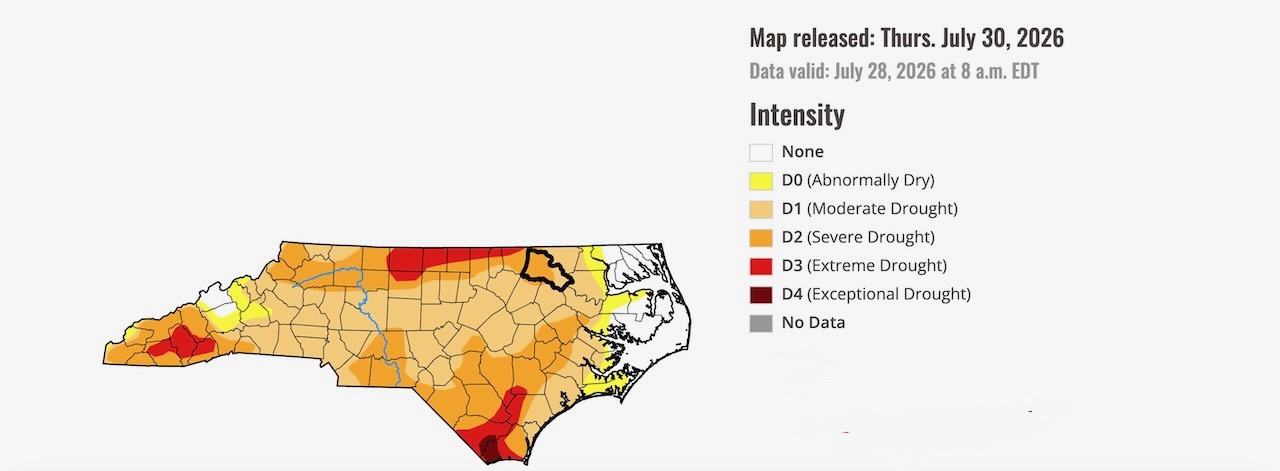
Throughout the state, North Carolina is still not in the clear as far as drought conditions, Governor Josh Stein said today.
Stein and Department of Environmental Quality Secretary Reid Wilson provided an update on ongoing drought conditions.
Currently, according to the U.S. Drought Monitor, much of Halifax County remains in severe drought status, while to the south, a portion remains in moderate drought status.
“After a dry fall in 2025, North Carolina had a very dry start to 2026,” said Stein. “Although recent rainfall has made a dent in the problem, we’re not in the clear yet. I encourage North Carolinians to check their local water system’s conservation status and do their part to use water wisely.”
“It may seem odd to talk about drought and continued water conservation after days of very wet weather, but we need to make up for months of extremely dry conditions,” said Wilson. “Everyone has a part to play in conserving water to ensure that we have sufficient clean water supplies to support our families and our economy.”
“The pattern of drier weather that we’ve seen since last August seems to have finally shifted,” said Klaus Albertin, chair of the North Carolina Drought Management Advisory Council and water resources engineer with the North Carolina Department of Environmental Quality’s Division of Water Resources. “We still have drought across the state, but most impacts are long term and will just take time and slightly above normal rain to improve.”
A wetter-than-normal July and significant rainfall from the past week have improved drought conditions in central and northeastern North Carolina, but many reservoirs remain below their normal levels for this time of year, and the public is still encouraged to conserve water.
Based on reporting from the US Army Corps of Engineers, the nearly year-long drought had reduced water levels to record lows. Streamflows are now near normal except in a few areas. Groundwater levels, which are below normal for this time in a typical year, will take longer to respond.
For example, last week’s rain caused water levels to rise in Falls Lake, Little River Reservoir, and Lake Michie in northern Durham County, but those reservoirs are still respectively 3.1 feet, 12.3 feet, and 8.8 feet below normal for this time of year.
The water level for Kerr Lake stabilized but did not rise and is at 5.4 feet below normal pool. Jordan Lake, spanning Durham and Chatham counties, benefited the most from the recent rainfall and is close to full. Wolf Creek, Bear, and Tanasee Creek lakes in western North Carolina are still below normal levels.