
Despite pleas from a majority of speakers Tuesday for him to resign because of comments his wife made on social media, Roanoke Rapids Mayor Emery Doughtie was resolute in his decision to fill out his term.
“It caused a lot of emotional kickback, a lot of hurt feelings that people were going to talk about,” he said of his wife Yvonne’s comments on a Facebook post last week regarding race, housing, and city schools. “It was wrong. I’m sorry that it went out to all the people and it created controversy amongst the community which we don’t want.”
Those comments came following the meeting, one in which he read a formal statement saying he would not resign. “I can only say that I will move forward and I’m not planning to resign.”
The mayor’s initial statement and a statement by Mayor Pro Tem Sandra Bryant renouncing racism came before the public comment portion of the meeting.
Comments
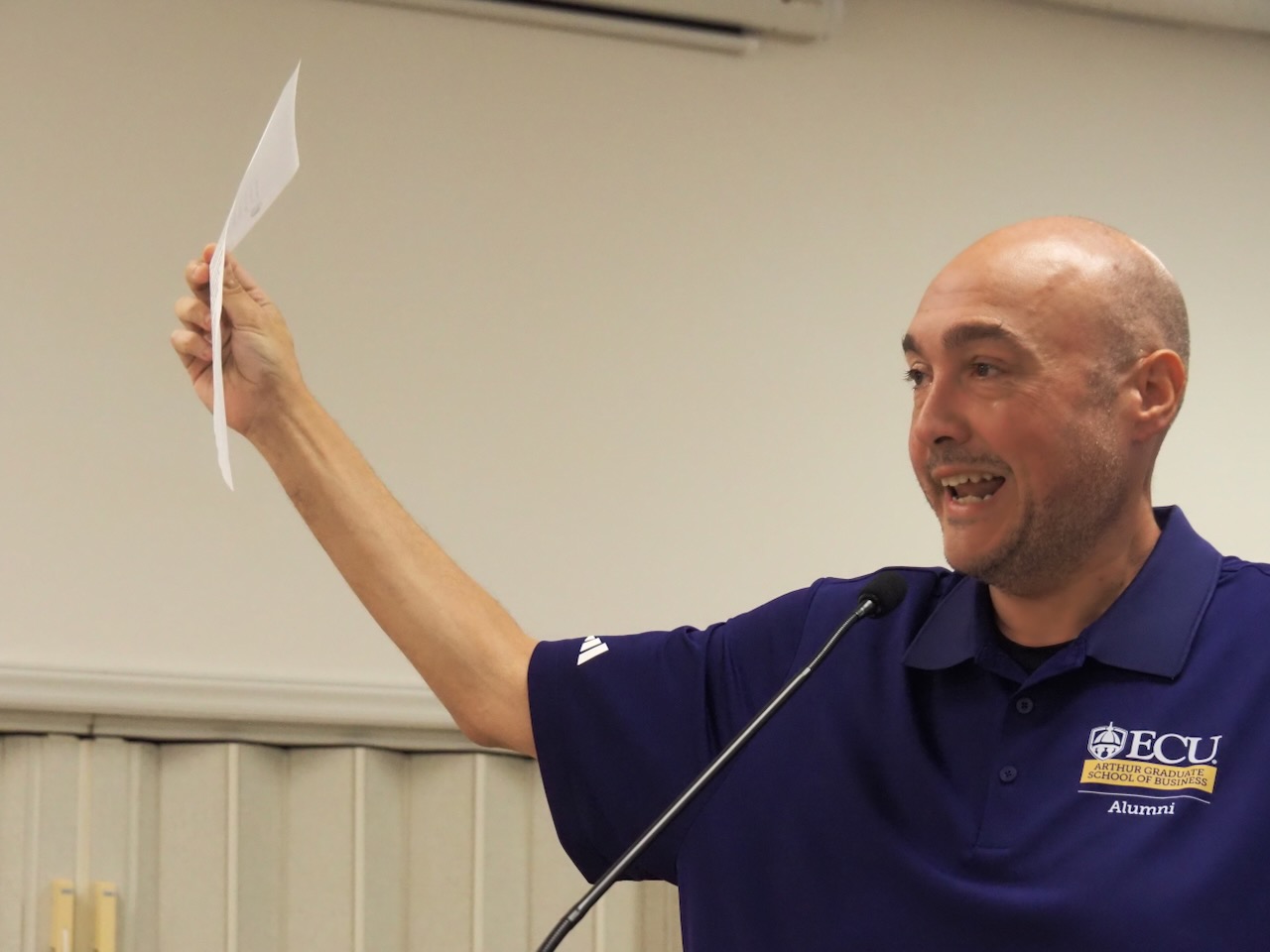
Holding a copy of Yvonne’s Facebook comments on a thread initiated by Jim Garrett, Roanoke Rapids resident Ephraim Brodsky said, “I want you to look at that last paragraph. These were her words — not allegedly, not accidentally, not potentially.”
That paragraph, which referenced perceived bad conditions in the western section of the city, said, “Another problem I have observed is the Black Citizens have moved into the City of Roanoke Rapids and RRHS and there has been a lot of problems with their housing area and in the schools. I am not saying all Black Citizens but a lot of them just don’t take care of their houses especially if they are renting. We have what I call a lot of Slum Lord Rental People that do not keep their properties fixed!”
“These are her words,” Brodsky said. “The whole town saw it.”
He said, “There is no moving forward with anything in Roanoke Rapids with Emery Doughtie as our mayor. None.”
Brodsky said he came before the council “as a proud, concerned resident who cares deeply about the safety, unity, and dignity of our community. As one of the only Jewish residents living in Roanoke Rapids, I know what it feels like to be part of a small minority. I know firsthand how quickly unchecked rhetoric escalates. Hate speech like this makes me genuinely fearful for the safety and well-being of my family in the very place we call home.”
It has been a full week “since the public learned of the explicitly prejudiced comments posted online by the mayor’s wife,” he said. “In that post she openly targeted Black residents, claiming that the arrival of Black citizens into our city and schools brought problems, while generalizing that Black renters do not maintain their homes or want to work.”
He said a further look into her social media platform revealed a disturbing pattern of anti-Muslim rhetoric. “Hate directed at one minority community inevitably threatens all of us. When you scapegoat Black families, students, and workers, or publicly target Muslims, you erode the basic fabric of safety and respect that every family in this town relies on. This isn’t just about one group. It’s about the collective security of the entire community, yet, despite the weight of these words, Mayor Doughtie remained completely silent until two minutes ago when he gave a weak, prepared speech.”
He criticized the mayor for not speaking from the heart and relying on a piece of paper. “For a full week there was no statement of condemnation, no repudiation of the rhetoric, no reassurance offered to the neighbors who now feel alienated and unprotected.”
Silence in the face of prejudice, Brodsky said, is neutrality. “It’s a clear signal of indifference to the fear felt by vulnerable families across Roanoke Rapids. The silence is especially painful because we live in a county still defined by its history. Much of the local wealth traces back to the plantation days of slavery and the very structure of our schools, with three separate districts right here in our city limits, was designed to keep neighbors apart.”
He told the council there is much work to be done to bridge these divides. “We can’t move forward if we allow our sundown town past to become our present.”
Silence is not an option, he said. “Leadership is tested in moments of crisis and this is your moment. I urge you to show true moral courage by standing up for all families in the city and publicly joining the call for Mayor Emery Doughtie’s resignation.”


County NAACP comments
Ray Harvey, president of the Halifax County Chapter of the NAACP, said Yvonne, as the mayor’s wife, should have known better than to post about Black people in a negative way. “In a segment of the population that this mayor is supposed to be serving, no one should ever, especially his wife, say anything negative about any segment of Roanoke Rapids’ citizens.”
Harvey said he waited to see whether the mayor was going to respond and denounce his wife. “Me, I would have denounced my wife and her actions for what she said because as a leader of this city when we take that role, we’ve got to take those roles seriously.”
Council members are in the public eye, Harvey said, just as he is when he dons an NAACP hat and shirt. “That brand has rules and regulations. To me, the mayor has lost control of this city. There’s no way that I think Black citizens will work hand in hand with you. I would like to see the mayor step aside and see new leadership. Heal this wound that his wife opened.”
Former NAACP president speaks
David Harvey, the former president of the county NAACP chapter, told the mayor how disappointed he was to read Yvonne’s comments. “I can’t say I was totally shocked, because nothing in Roanoke Rapids shocks me. The stench is so deep that sometimes it just comes out and it gets past the people before they realize it.”
David said Yvonne’s comments crossed a line in many ways. “When you look at what she said and point the finger completely at Black people in this city, I have to concur with the current president and others who will come after me.”
He told the mayor that he has known him for a long time, but said, “It’s time for you to go. It’s time for you to step aside. Your wife is an extension of you. Each and every one of you who’s up there that has a spouse, you are a public figure, you lead this city. Your spouses are an extension of you. It’s not OK, it is not good enough to just say, ‘we’re sorry and this shouldn’t happen.’ We know it shouldn’t happen. She even mentioned the Roanoke Rapids Graded School District. That has been an issue in this county forever and it’s part of the reason why there’s so much divide in this county.”
Citing his longtime work alongside the council, David asked members to ask the mayor to resign. “It’s time to move on so we can start to recover.”
Garrett speaks
“I see that people are blaming the mayor and they’re blaming y’all because y’all are silent,” he said. “That’s what I’d recommend you to be because if you say anything it will be used against you. Silence is your only revenue.”
Garrett said he has met the mayor’s wife but added they were not close friends. “We don’t visit each other, but I don’t believe the woman is racist. I don’t believe he’s racist. I believe it was a bad situation and I believe it was brought on by the fact you, as administrators of this city, are leading the city in the wrong direction. Our housing is falling down, our inspection department is not working. We’ve got drug houses.”
Throughout the controversy, Garrett said he keeps hearing the term racial. “Today, I counted how many racial remarks I heard. I heard 14 racial remarks. Not a single one came from a White person.”
He said he has worked in one of the mill village areas that a previous speaker had referenced. “There are 13-year-old boys carrying guns. We heard that people are saying they’re afraid. They may be afraid, but they are armed and we know when we are working down there we don’t confront anybody. We stay silent because silence is the best thing to do.”
Garrett said the city needs a new leader, but it was not the mayor he was referring to. “I would recommend that we need a new city manager.”
Desiree Thomas
What stood out to Thomas was the part of Yvonne’s comment about Black people moving to Roanoke Rapids. “My great-great-grandmother was from here. She just wasn’t dropped off in Roanoke Rapids.”
She said her great-great-grandmother lived in a time when Black people were told “where they could live, where they could work, where they could sit or whether they could voice their opinions whether it mattered or not. My family has generational ties to this community as well. If Roanoke Rapids is concerned about neglected properties, address the neglected properties. If landlords aren’t maintaining rentals, hold the landlords accountable. If there are code violations, enforce the code fairly across the city. Don’t pick and choose where the rules and regulations apply.”
Attaching those problems specifically to Black people, she said, creates stereotypes. “When you create stereotypes, you create angry people. Black people in Roanoke Rapids are homeowners, we’re renters, we’re vendors, we’re teachers, we’re nurses, we’re business owners. We’re parents, we’re taxpayers. While we’re discussing what Black citizens supposedly aren’t doing, let’s talk about the things that are happening when we’re trying to do something.”
The barriers that have to be overcome are not always equal across the board, she said. “Hold every race according to the same standards, regardless of their race, their neighborhood, their name, their connections, or who it is that they may know.”
Citizens have been quiet long enough, she said. “We’re going to continue to attend these meetings. We’re going to ask questions. We’re going to pay attention to the decisions that are being made, and we’re going to expect accountability, and we’re going to trust we’re representing all of Roanoke Rapids because Black people are not outsiders in the city of Roanoke Rapids. We buy property, we build businesses, we earn degrees. We serve the country. We raise families and we’re invested in this community like everybody else. We are Roanoke Rapids too whether you like it or not. We will not sit in silence and be stereotyped.”
James Mills
Mills said the comments made by the mayor’s wife “took the face which America has been trying to erase for at least the last 50 years and put it back on the city of Roanoke Rapids. Every graduate of Roanoke Rapids High School, every citizen who travels anywhere, will wear the face that Roanoke Rapids is a racist town. Roanoke Rapids believes that its problem is Black people.”
Carrie Tuning
Tuning, a minister, said she was taken aback when she read Yvonne’s post.
Addressing the mayor, she said, “Until this evening you had not been proactive and addressed the situation. You read a prepared statement that you said you wrote and I have no doubt that you wrote it.”
She then turned to Garrett, who was sitting close to the podium, and told him, “I am not in agreement with you that the city manager should step down. The city manager is not the mayor, nor was it her that wrote the statement. What I’m saying is that when we start attacking one segment of the town here in Roanoke Rapids, we are not being honest.”
In the city, she said, “We have people that are slumlords, that are addicts that are all different colors. We have a problem here in Roanoke Rapids and it is not only coming from Black people.”
Tuning told the mayor, “There is no way that you or anyone on this council can convince me that you don’t know the heart of your wife.”
She said that Yvonne should have been at the meeting and should have made a public statement. “And maybe you can give her that message when you get home.”
Terry Buffaloe
Buffaloe said the country has a history of racial disparity, inequity, redlining, and Jim Crow. “All of that stuff has trickled down, making some of what was in her statement true. But she didn’t go into the reasons for it. That Chaloner Park that they think so much of was built mostly off the backs of the World War II veterans' benefits that they got to purchase homes that Black people who fought in every war in this country did not have the opportunity to have.”
It has always been the Black community that has gotten the least amount of money to educate their children generation after generation, he said.
Marya Murray Diaz
Diaz told the council that “racism is a White person problem. We have to handle it among ourselves and protect folks from having to always stand up and speak out. I really think that people with less melanin in our skin need to speak out in these moments of stress, discomfort, and incorrect speech. We all need to say something. We can’t sit back.”
As a resident of the Chaloner Park neighborhood, she said, “I have the nicest, kindest neighbors I’ve ever had in my life. They go out of their way to include me.”
Thinking when she first moved into the area she would be an outsider, she said she is now part of the family.
Diaz said there is an assumption that people with fewer resources are inherently bad. “It’s our responsibility as community members and the city council to do something about it, to lift everybody up — all of us up.”
She wanted to know what was going to happen moving forward. “After George Floyd was murdered there was an advisory committee. That kind of petered out. I would love to have some sort of organization as of this moment to move us forward as a city to cross those silos.”
Diaz said communication is needed to help people get together across racial, economic, and religious backgrounds to “get to know each other because I think moving forward is more important than what the problem is as of this moment. This is going to be history because folks who are racist and classist are not going to be in charge forever.”
Joyce Harrison
Harrison said the mayor never addressed the issue until the council meeting. “He never came forward to say anything to anybody about what his wife said. I’m just kind of upset about it because I would have never thought his wife would have been that type of person, but she’s kind of a wolf in sheep’s clothing.”
She said she was glad to see people come out and share their opinions “because clearly, I think the mayor needs to resign at this point.”
Jay Wright
“There are plenty of White folks who are upset about what has happened here and what has transpired in this thing,” he said. “Some people want to make it seem like it’s divided in half. It’s not.”
Wright said that by and large, people want leadership that looks out for everyone. “Not just the ones they like, not just the ones they think are going to help them out, not just the ones that are stopping them from taking over the town.”
He said, before abruptly ending his talk, “No one in this town is going to take this away from the working class. I know you want to, but you’re not going to and if you ever blame White people like that again …”
Crystal Johnson
A longtime resident, Johnson said what the mayor’s wife said “is truly what has happened in Roanoke Rapids. As we look around in the city, all of the businesses that are not franchised by Scott Aman, everything else is left to the Mexicans, the Chinese, and the Arabs. There’s no room for us in the city. What she said was absolutely true. We were a sundown town then and we’re acting like one now.”
Terri Chichester
A Roanoke Rapids resident who has lived in Halifax County most of her life said, “Nowhere is without problems. Not one place. However, I would like to say that in my humble opinion, Yvonne Doughtie had the First Amendment right to say whatever she wanted to say. There are consequences for what you say. I was brought up with sticks and stones that may break my bones but they never hurt me.”
She said, “I find there’s an awful lot of hate speech and rhetoric being thrown around. Just because we don’t like it, doesn’t make it illegal. I’m not saying it was OK. I’m just saying she had the right to say it.”