

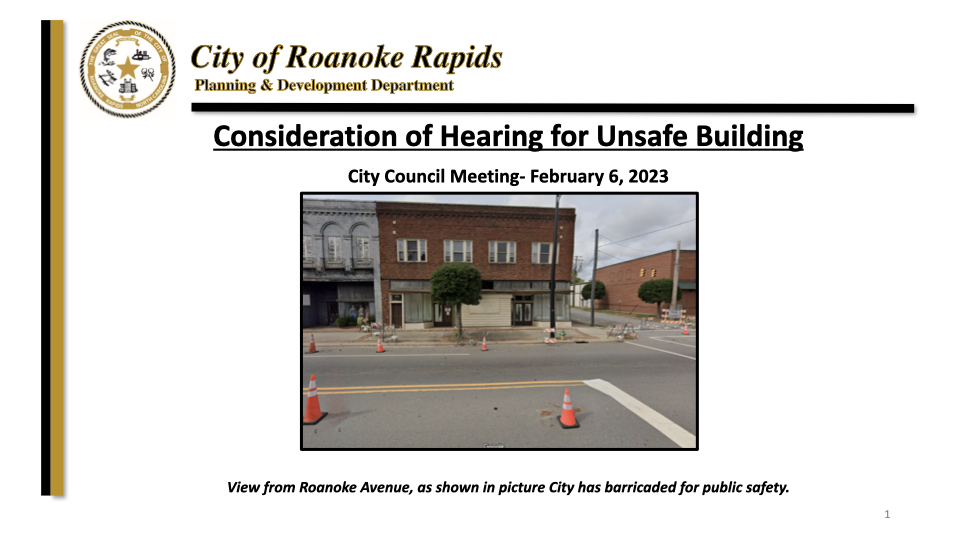
The city may consider re-advertising demolition bids for the former B. Marks building located at 201–203 Roanoke Avenue.
The estimated cost of the demolition is $500,000, City Manager Kelly Traynham said after Councilman Andy Jackson asked for an update Tuesday night.
“We have an order for the demolition and removal,” she said. “The owner of the property has not complied with that order. We have the authority to complete the demolition in this case.”
The finance department solicited bids in April, and one was received for $500,000. “At this time, the project is not funded. That’s where that stands at this point.”
Mayor Emery Doughtie asked what would happen if the city reached out to the owner and bought the former general merchandise store from them.
“That’s a dangerous choice for the city to make unless we are 100 percent certain that we’re going to get that funded,” City Attorney Geoffrey Davis said. “That's a dangerous choice. I think it would be trivial for us to take it into our possession and then suddenly we have that liability. If the building were to fall down today and hit somebody, that’s not the city’s problem. It’s not our property. Just because something happens in the city of Roanoke Rapids, it is not a city liability issue or our problem. If the city owns that building, it is absolutely our problem.”
Davis said the city could clean up properties. “The city would have the authority through various statutes to condemn and clean up a lot of properties that are derelict, that have become a public nuisance, that are in need of demolition or repair. We have the ability to do that.”
But, he said, “We can very quickly bankrupt the city doing that because there are costs that fall on us.”
In the gallery: Slides from a 2024 discussion of the building


The only way to fund those costs would be to take $500,000 out of the fund balance and demolish the building. “I certainly do not suggest that. Our budget is our budget. There’s not really a lot of give there. There’s only one other place the city could get funding this fiscal year, and that would be the fund balance. In a longer-term program the city — and I even hesitate to say it — could raise taxes to fund the demolition,” Davis said. “Unless there’s some kind of outside grant or someone that’s going to give the city money for the demolition of the building, the assumption is that is money that is going to be spent by the city and is not going to come back. The idea that you’re going out and demolishing the building and essentially creating a vacant lot — what is the value of a vacant lot at the corner of Second Street and Roanoke Avenue? Probably not very much. Certainly not $500,000.”
The B. Marks building has come to the end of its lifespan, but it can’t just be bulldozed. “With the level of asbestos contamination, there’s no other solution. You can’t remediate that. Unless the state creates some kind of program tomorrow or some wealthy benevolent millionaire wants to give us some money to take care of it, the only way that the city funds demolition is by either essentially taking it from our savings or creating new revenue to that level.”
The city continues to look for and pursue remedies for the building, Traynham said. “It has changed ownership since the council adopted the ordinance on it. I think the owner of record has maybe corresponded with the planning department one time.”
Councilman Curt Strickland asked about the possibility of re-advertising bids for the demolition of the building.
“We can revisit the project and see what we can come up with and see what the return is,” Traynham said. “We have advertised that for bids a few times, but because of the anticipated costs, we do have to follow state procurement procedures and receive a certain number of bids.”
Standalone buildings are much easier to deal with, she said. “When there are shared walls, there are also structural conditions that you have to be aware of and concerned about.”
An earlier bid put the cost of the project at $250,000, but inflation has driven the cost up and the majority of the price tag has to do with the disposing of the material, Traynham said. “There’s a lot of brick, metal, and wood, and those materials, assuming contamination, have to go to an asbestos-receiving landfill under certain treatment conditions.”
Davis said state laws actually require the city to assume materials in these buildings are contaminated. “It’s not that we’re guessing they are; we know they are, and because some part of that structure is, the law forces us to treat all of the materials that come from that site as being contaminated. It’s not like somebody can sit there and kind of sift through and say, ‘Well, you know, this is asbestos-contaminated, but this part over here isn’t.’ We are required by law to assume all of it is.”
Many times, because of unsafe conditions, a full asbestos survey isn’t allowed to be performed, Davis said.
Traynham said, “Generally, under the normal process, you’d have to remove the asbestos before you’re issued a demolition permit, but the unsafe conditions warrant that we were not able to go in and effectively remove the asbestos-containing materials prior to starting demolition activities. So everything has to be treated as asbestos through approved methods through environmental services.”
Doughtie said, “I think we need to continue to try every angle and see if there’s any money that can come from somewhere.”
Traynham said there is a Brownfields Coalition meeting next week in which the 2027 application period will be discussed.
The city has unsuccessfully sought Brownfields funding. “It’s a very competitive program through the United States Environmental Protection Agency,” Traynham said. “People all over the United States review different locations. Our applications have been competitive, but there’s not enough money to serve all those grant applications.”
Buildings across the country have the same conditions, she said. “They were built 100-plus years ago, but really the owners failing to maintain and then neglecting their properties is how we end up where we are.”