
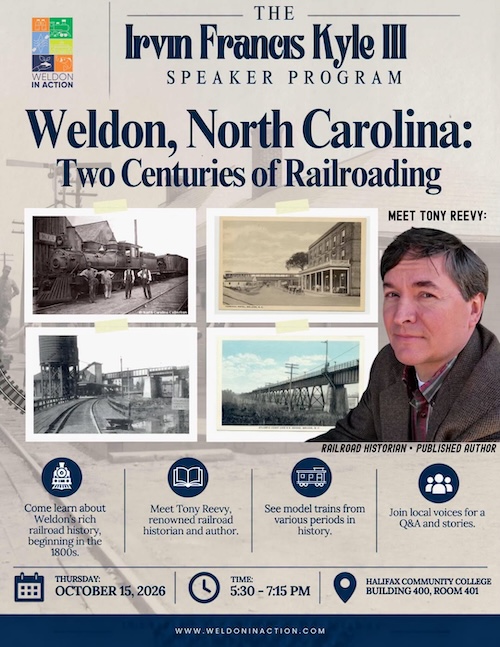
To demonstrate and highlight how Weldon’s enduring railroad presence remains a vital thread in its story of persistence and progress, Weldon in Action will host railroad historian and author Tony Reevy for his talk Weldon, North Carolina: Two Centuries of Railroading.
The program is part of WIA’s Irvin France Kyle III Speaker Program, a free public event that will be held Thursday from 5:30 to 7:15 p.m.
Reevy, a retired NC State University civil engineer and train scholar, will lead the discussion at Halifax Community College in building 400 room 401, where he’ll display his railroad artifacts and book selections. Model trains from various periods in history will also be part of the presentation.
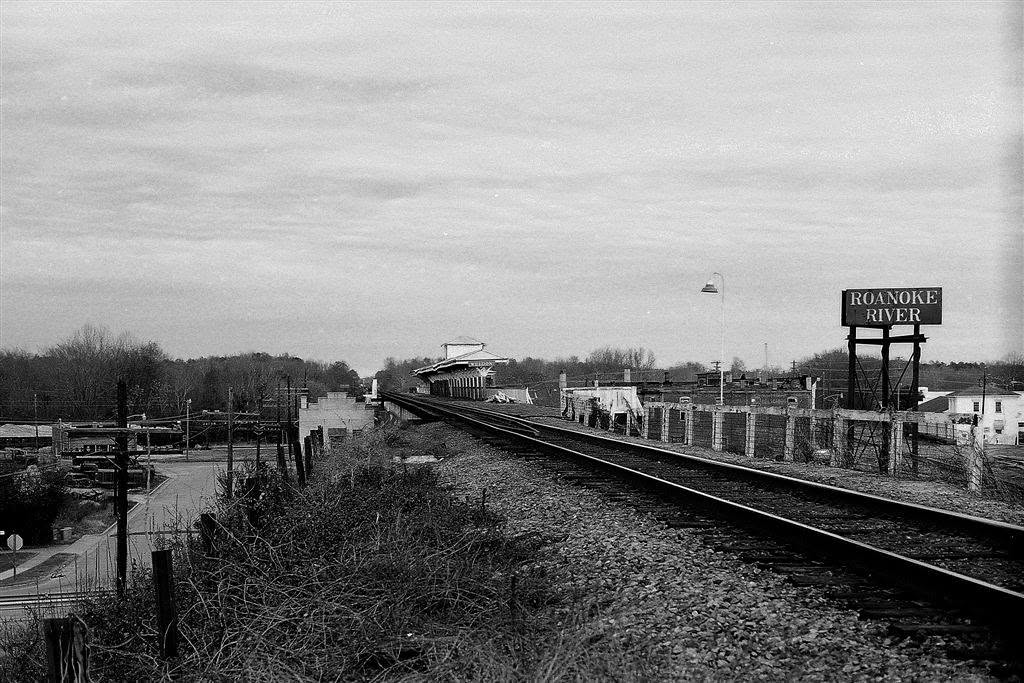
“Weldon, during the late 1800s, was a crossroads for four different railroads so it was an important railway center for its times,” said Reevy. “I barely remember it as the crossroads. We have two railroads, and for most of my life, it has just been one railroad, now called CSX.”
To fulfill its charge of building a stronger, connected community of neighbors, WIA’s speaker series is an initiative that celebrates Weldon’s culture, heritage and history through storytelling and scholarship. Local voices, including WIA members as well as current and retired CSX employees, will share stories of the town’s railroad glory days.
Weldon native and WIA founding member Alice Joyner Irby said the railroads, notably the Wilmington-Weldon Line, were so important to the town’s growth and prosperity in its early days.
“Weldon was known as the ‘town with the top on it’ because there was a huge shed on the 100 block of Washington Avenue,” she said. “The shed was over the tracks to reduce noise and protect the travelers who were going to the hotels.”
She added the railroads transformed the region into a hub of commerce and transportation, reshaping the town while building a legacy for its future.
“When I was growing up, we loved – we lived – with trains,” Irby said. “I want to tell stories about walking the rails when it was against the rules. I lived across the street from the railroad tracks. They were seductive – I just couldn’t stay away.”
Reevy noted he plans to discuss the golden days of railroads across America and in Weldon as well as their decline. He said he will also talk about the reinvigoration of railroads, what he calls a “partial rebirth,” the consolidation of the railroad industry and the role of trains in economic development trends related to commerce, tourism and recreation.
He said he sees the need for a “more balanced and diverse transportation system in the United States,” that trains can offer technological solutions for the masses, much like the much anticipated plans for revived railroad activity in Weldon and other parts of the east coast.
“Freight trains are already robust in the US but passenger trains are not,” he said. “Traditionally, if you look back over the last 60 years or so, whenever fuel prices go up, people look at railroads because they know they’re inherently more efficient than trucks and cars.”
He added that research reveals passenger train travel is generational, stabilizing at low levels in the 1980s, and that unless they lived in metropolitan areas, younger people rarely consider that transportation option.
“Train travel has gone out of the national consciousness,” said Reevy. “I think that’s one of the reasons we don’t go back and access the advantages of passenger rail.”
Reevy, a train scholar who with his wife has crossed the country twice on Amtrak from Chicago’s Union Station, noted his most surprising research discovery – which led to his first book – is the tenacious influence of railroads in art, literature and folklore.
“We’re coming up on Halloween, so yes, it’s certainly in ghost folklore,” Reevy said. “The Wilmington-Weldon Railroad has several ghost stories about it.”
He also noted the influence of trains in music, especially the alignment in country and bluegrass songs.
“Even in rock and roll, you’ll find trains,” Reevy said. “If you look back to the beginning, ‘Mystery Train’ was one of the first songs Elvis Presley recorded.”
To learn more about Weldon’s history, and the role the railroads played in it, visit Weldon in Action’s website at this link