

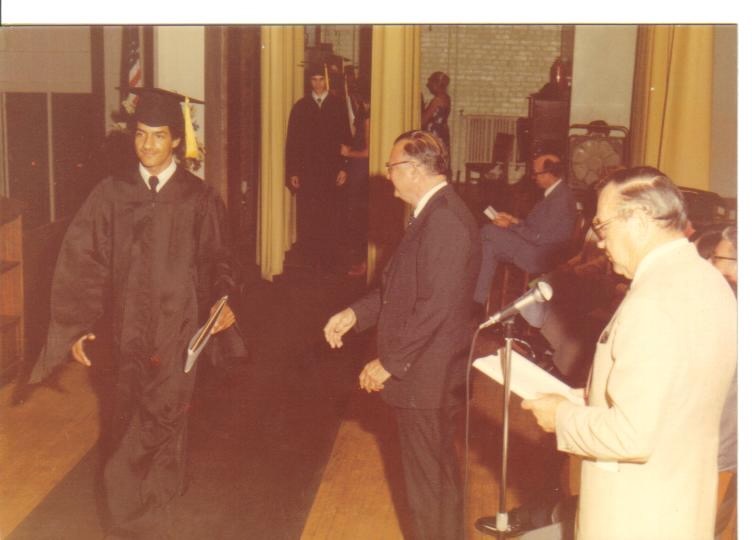
The house on Wilkins Street is long gone.
It was what Craig Ivey described as substandard rental housing. But it was also a place where he heeded the words of his late mother, Ida.
Ivey, who was in town for his Roanoke Rapids High School 45th class reunion, is a retired president of Con Edison, the company that supplies electrical power to New York City and Westchester County.
Roanoke Rapids, however, was the place that laid his educational groundwork to eventually become the number-two person in the company, responsible for 14,000 employees.
It all started with his mother’s influence. “My mother was a guiding light in my life,” he said at William R. Davie School this morning before giving a talk to students there and then moving on to Weldon and Roanoke Rapids high schools. “I grew up with a single mom who was a short-order cook. She worked at Claude’s Restaurant. She went to work early in the morning, and I always wanted to be a source of pride for her because I knew her life was already difficult.”


He decided, “I was always going to bring positive news home for her and be positive for her. I carried my mom around on my shoulder.”
In other words, he said, “I passed the mom test. I’m not perfect, but I passed the mom test substantially and I wanted to make her proud. I wanted to get an education and support her so she could retire. My mom worked her whole life for not very much money.”
In 2003, she died at the age of 69. On her deathbed at UNC Hospital in Chapel Hill, Ida was preparing to be taken off a respirator. “She knows she’s going to pass away. She’s gathered all of her kids to say goodbye. This is a lady that never made much more than minimum wage. One of the last things she wrote — she couldn’t speak — was, ‘Pay my bills.’ That represents the integrity, responsibility, and reliability of my mother.”
Despite growing up in a substandard house, he said, “That’s where I come from: a legacy of integrity and responsibility. That comes directly from my mother. She’s a guiding light in my life.”
That influence from a woman with a ninth-grade education instilled in him a work ethic — collecting bottles for deposits, cutting grass, picking up trash, and working as a bag boy at Kroger.
The winner of the 1981 Joseph W. Talley Scholarship, he was also a summer intern at Dominion while an electrical engineering student at North Carolina State University. That led to an associate engineer position following graduation.
It was one of his classmates who suggested sharing his story with the students. “I was a little reluctant to do that because I’m internally proud and externally humble.”
But, he said, “I thought there was an opportunity to talk to young people, and my idea for today is if I can inspire just one young person to see there’s a positive future available to them in the current circumstances in this county, I want to do that.”
Looking at statistics recently, Ivey said, “Halifax County is one of the most distressed counties in the whole state. I want to come and bring a message of hope, optimism, positivity, and opportunity because that’s been my story. I grew up here. I grew up in substandard rental housing, but I think you can overcome that. You have to work at it.”
Ida had 20 grandchildren, and 16 of them are college graduates. “It can be done. You have to work at it. You have to focus on it, so the core things are education, skill, and craft.”
Then there is a set of values that guides you, he said, and a moral compass “that causes you to do the right things every day and never do the wrong things.”
That comes full circle to passing the mom test.
He also encourages the students to surround themselves with like-minded people. “Like-minded people that want to aspire to greater things, and run from those people that might take you down the wrong way.”
Born on Dixie Street in a midwife delivery, Ivey told the students he had seen the rough side of the streets. “My street was a busy street. On Saturday night the place was buzzing. There were people drinking beer, people playing pool, and people selling drugs.”
Drug dealers wore carpenter aprons with a gun in one pocket and marijuana in the other, but they never messed with him or his friends. “They knew we had something different that we were aspiring to become.”
One of the things Ivey and his family have done to keep their mother’s memory alive is establish the Ida M. Ivey Foundation. “A part of that is remembering where we came from and giving back to the community. We know what it’s like to be poor. This is part of giving back. It’s part of saying this is where we came from. We know it’s tough. We know you may not have all the resources you need because we were there. We know what that looks like. We can’t solve all the world’s problems, but we can contribute and try to be a positive example.”
And, he told the students, it’s not always about the four-year college route.
While Ivey loved school, his brother didn’t love school like he did. Instead, his brother went to Halifax Community College and now, after a long career at Newport News Shipbuilding, he’s about to retire. “I think he ultimately decided that he needed a skill. He needed a craft. He’s welding on submarines. They don’t just let anybody weld on a submarine.”