

The answer to the question posed by Roanoke Rapids Finance Director Carmen Johnson last Tuesday is obviously a tax increase — but it must be one that not only stops the financial bleeding but actually gets things done.
Her comment to Mayor Emery Doughtie echoed exactly what we had been thinking throughout the city’s budget deliberations that night.
“I want to point out that Roanoke Rapids has the lowest tax rate of any municipality in the general area," Johnson said. "When I first came to work here, I was like, ‘Oh, we need to raise taxes.’ With a million-dollar theater debt a year, that’s a lot. And if you’re not raising your taxes and you’re not getting any new revenue, what are you supposed to do?”
By "getting things done," we’re not talking about a hefty hike that would bring a fleet of ugly Tesla pickups to the Public Works Department, pay off the remaining theater debt before 2032, or fund any other extravagances. We’re talking about a tax rate increase that could improve facilities, add badly needed funds for the demolition of blighted property, and make long-overdue repairs to city-maintained streets.
City residents have already made it clear that they support recreation, trash pickup, and leaf collection. They have made it clear they support police and fire protection. Defund or reduce any of these services and we guarantee there would be more anguished cries from residents than if a tax increase were enacted to preserve — and perhaps improve — the services they have become accustomed to.
That includes services like the knuckleboom truck that patrols alleys and streets to pick up discarded debris. County residents don’t have that luxury; they must rely on friends with trucks to help them carry discarded items to convenience sites — or, as we’ve seen several times, they simply toss them into a ditch or the woodline. Then there are the machines that collect leaves raked during the fall and winter. In the county, the primary option is burning yard debris, which becomes problematic during the droughts we often endure and when windy, dry conditions persist.
The rub when discussing tax increases is that politicians often believe they are doing their constituents a favor by keeping tax rates stagnant while, year after year, raiding the "piggy bank" — also known as the available fund balance — to balance the budget. To us, it’s merely a plot to curry favor with voters or protect their own business interests. Sooner or later, when you keep dipping into the fund balance, you have to face the consequences. As far as we’re concerned, that time has come.
Politicians also like to say governments should be run like a business. One of the first rules of business is that you don’t dip into your savings just to stay afloat. Ultimately, you pay the price for that.
If we learned anything from chainsaw-wielding Elon Musk and his former pal in the White House, it's that government is not business and business is not government. Just last week, we read some of the Washington Post’s Pulitzer Prize-winning work on DOGE and the cluster it became, again showing the vast differences between the way governments and businesses operate.
We could rail for days on DOGE and a very murky, possibly illegal, war — or “little excursion” — into Iran and what it’s done to consumers across the nation, but we’ll bring this back to Roanoke Rapids.
“Ultimately, we’re either going to have to cut some services, reduce our burden, or increase taxes,” City Manager Kelly Traynham said. “There are things you can say you want to try to do, but you can’t approve a budget that doesn’t pay for everything you’re obligated to do.”
Traynham’s next comment cuts to the heart of the matter. There are certain things cities are required to provide by general statutes, such as city administration and a planning department — which often gets little funding attention.
And then, she said, “There are preferred options we have in place because the city taxpayers have supported that — a professional fire department, a police department, and a parks and recreation department.”
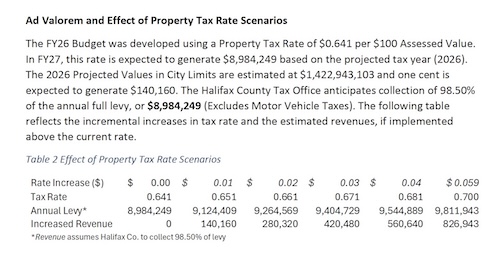
In her budget message to the council, Traynham presented six scenarios. The first option — doing nothing — is not an option. The second one is better, but we would argue for the third: an option that sets the tax rate at 66.1 cents per $100 for a revenue increase of $280,320. We would even go out on a limb — the kind the Public Works Department collected plenty of in the aftermath of the May 2025 storm — and suggest a 67.1-cent tax rate, which would mean a revenue increase of $429,480.
Can the city afford to lose these services? No. Cutting any of them will result in a diminished quality of life, affect crime rates, and potentially cause harm to residents and visitors alike.
That is what the city council should keep in mind: Cuts are not going to help the city thrive, and a tax increase that only serves as a bandage won't either — Editor