

Two people spoke Monday night as the Halifax County Board of Commissioners continued its road show — this time meeting at the Lloyd Andrews City Meeting Hall in Roanoke Rapids.
The topics were how county tax dollars are benefiting Roanoke Rapids and the recent controversy involving the Quiet Data Centers Halifax land sale closing.
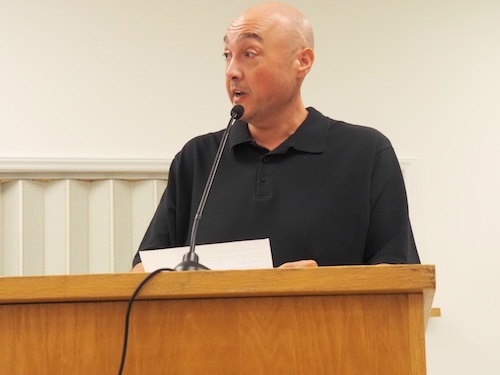
Ephraim Brodsky
“Roanoke Rapids is the economic engine of Halifax County, but our tax dollars are treated as an extraction fund rather than an investment in our people,” Brodsky told the board.
He said Roanoke Rapids generates between 65 and 75 percent of all local sales taxes collected across the county. “Yet only 20 percent makes its way back, generating an $8 million to $10 million annual surplus that the county spends elsewhere.”
He said Roanoke Rapids residents contribute around $10 million in ad valorem property taxes each year, and most of that is for residential units. “Our highest business payer is the paper mill, which pays $80,000, as opposed to Roseburg in Weldon, which by itself gives the county $1.5 million a year.”
Hotels along the I-95 corridor in Roanoke Rapids generate 80 to 90 percent of the county's occupancy tax. “We pay our full share of county taxes, but we have to double-tax ourselves through municipal levies just to maintain basic services.”
Roanoke Rapids taxpayers, he said, subsidize the county sheriff’s office while funding their own police department. “We support 911 dispatch while fully funding our own fire department, which routinely provides unpaid mutual aid outside city borders.”
The county fully funds five municipal library branches in Enfield, Halifax, Littleton, Scotland Neck, and Weldon, he said. “The combined population of all five of those municipalities is less than the population of our municipality, yet inside the borders of the largest, most populated city, the county library system invests zero dollars. The Roanoke Rapids Public Library serves more patrons and has higher circulation numbers than the entire county library system, but it’s kept afloat solely on the backs of city taxpayers.”
The same is true regarding recreation. “When Halifax County created the parks and rec department and pursued facility grants, the investments went to unincorporated sites like the 4-H Rural Life Center in smaller jurisdictions, while direct investment in Roanoke Rapids remains nonexistent,” he said. “Scotland Neck received a half-million-dollar playground grant for a town with fewer than 250 young children, while Roanoke Rapids, which is home to 2,220 kids under 12, was completely bypassed.”
The city’s parks and recreation staff welcome residents from across the county to its facilities daily, he said, “entirely funded by city property owners.”
Brodsky said the city is not asking for special treatment — only basic fiscal equity. “Roanoke Rapids taxpayers cannot continue paying double for services the county provides everyone else for free. It’s time for Halifax County to do better. Partner with Roanoke Rapids directly. Fund our library as a co-equal anchor of the county system. Invest county capital into the parks and recreation facilities our families rely on, and treat the city that powers this county with the fairness and respect it deserves.”
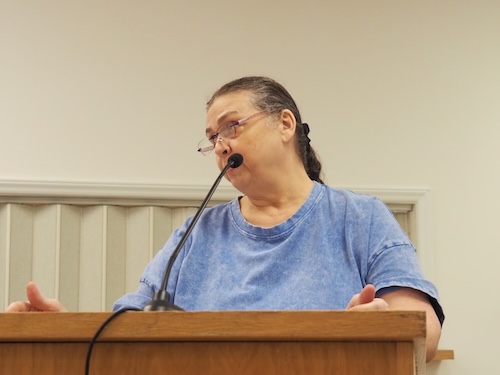
Donna Patterson
“You guys held the cards on this data center deal,” she said. “Data centers are wanting to build everywhere and are being turned away. We had a perfect place for one to come here. You didn’t have to sign a nondisclosure agreement, but you chose to because you knew we citizens would fight it.”
She said the county didn’t want the fight. “You went and did it in secret, and when asked at the meetings if y’all were planning a data center, y’all lied and said no.”
She questioned the 50-job requirement QDCH is supposed to adhere to. “Those jobs are not really guaranteed as far as I can see in the agreement because the data center can pay a fine of $2,500 a year per job that doesn’t get filled. That means that some citizen is not going to get a salary, and they’re not going to get benefits. We’re not going to get their taxes.”
Patterson said she wanted to know “what was discussed at the meetings about the data center behind closed doors, because only Commissioner Gary Redding seems to have done any research on data centers. You all should have listened to him at the last meeting.”
She asked the board whether they met with any other counties or cities about their experiences and what they got out of their deals. “Were there any problems they had, anything that they could suggest you put in the deal? Have you thought about what a fire hazard these places are — the CPUs, the GPUs, heating and cooling, chemicals, generators? Have you thought about how these things will be handled by emergency services? The runoff? How you made this decision without seeing environmental reports and without doing more research is beyond me.”
Patterson said it’s not about the people not wanting a data center if it’s really beneficial. “It’s the poor deal made. I would like to know if any real estate agents or lawyers got any fees out of this deal.”