

The message has remained unchanged since Monday, when Roanoke Rapids Graded School District Superintendent Bennett Jones discussed the Needs-Based Public School Capital Fund grant with county commissioners.
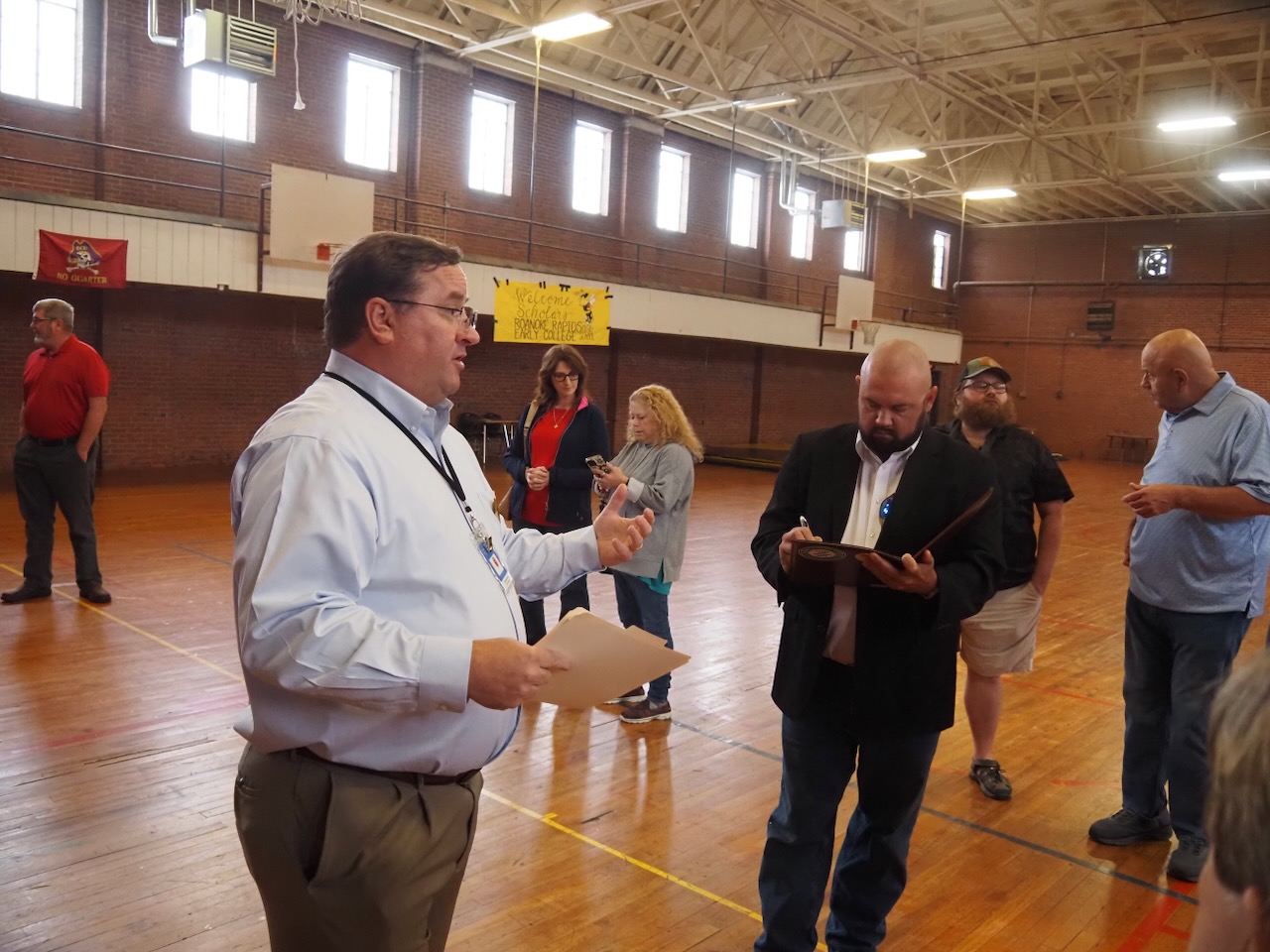
It all comes down to the school system being awarded the $52 million grant that would bring a new Career and Technical Education center and early college together, he said at the armory beside Roanoke Rapids High School on Thursday.
During Monday’s county board meeting, Jones told Commissioner Thomas Barrett that the armory could be demolished to make way for the new construction should the grant be awarded.
The plans also include a new gym on the RRHS campus, as well as the development of the former Patterson mill site on Jefferson Street to provide new athletic facilities for baseball and softball, tennis courts, and a multiuse field.
“If we don’t get this grant, we’re not really doing anything,” he said. “We’re just kind of sitting around, and we’re going to keep doing renovations when we can.”
Long-term needs and funding realities
He said the problem is that the grant is not going to cover all of the district’s needs. “The needs we have here are bigger than what this grant is going to cover. The grant gets us going.”
Jones said he is tasked with looking at the district’s future needs. “I’m trying to think about what we’re going to need 10 years, 20 years, 30 years, 50 years down the road for that high school to continue to be sustainable for what we’re trying to do.”
Money the system has budgeted for the armory, which houses the early college, is earmarked for projects such as upgrading classroom space and bathrooms. “Capital outlay money comes from the state to the county, and it’s completely based on average daily membership,” he said. “So as we continue to lose students, that money is going to get smaller and smaller each year. If you look at the historical transfer enrollment in the district, it has been on the decline and it’s forecasted to continue to decline, so you’re going to get less and less money from the state for the county to deposit.”
That remains the picture unless there is a windfall from the legislature for investing in old buildings. “Then we would all benefit, but we don’t know of anything on the horizon.”
One reason plans were scrapped for a new middle school—which would have allowed Chaloner to house the pre-K and alternative programs—is that the state Department of Public Instruction does not oversee pre-kindergarten education. “It’s run by the Department of Health and Human Services, so DPI is not going to use its money to support what Health and Human Services does, even though it would make sense logically,” Jones said.
He noted that he came into the job with no biases. “What I see is we have a lot of aging properties, and it’s on me to figure out: If we only have 2,400 students, am I better off serving four places, five places, or seven places to cover 2,400?”
The ACES alternative school, for instance, has maintenance needs and costs the district about $60,000 a year to operate for 12 students. “That doesn’t feel very good to me as a good use of our dollars. I would rather use that $60,000 where it’s going to help 600.”
The condition of the armory
Through the grant application, Jones said he is looking at how the school system can be the most competitive. “The point I was trying to make is that no plans have been made other than a concept. There is no site design; there’s no concept of what the front of the building is going to look like. This is a concept, but if we don’t get the grant, it’s just a dream, so we’re trying to figure out how to turn a dream into a reality. Once we get into reality, then we can figure out how we make this work.”
Councilman Rex Stainback noted that the armory is more than 80 years old. “The floor we’re standing on is over dirt. There is no foundation. What is going to happen to this floor in another half a century? There’ll be a lot of maintenance on this building.”
Stainback said he was also concerned about the roof of the armory. “Many years ago it caught on fire, and a lot of the beams were salvaged, but they were charred to some degree. They painted over the charred beams, so you don’t see it now.”
He said there are also places where the roof shows signs of leaking. “What’s going to happen to the roof in another half-century? It is a place I would like to keep, but I'd like to see a new school built. It’s not on the historic register. It’s in the historic district, but I think it’s lived its life.”
The armory, as the name implies, was not designed to be a school, Jones said. “They did some renovations, like, 10 years ago. The classrooms are adequate, but if I’m going to try to build something, I want to replace adequate with the best, or very nice, or very good. I think our kids deserve that opportunity.”
Heritage, concerns, and moving forward
He said he understands that replacing something makes people feel as though they are losing some of their history and heritage. “I think it’s important, and I’ve said this many times and I’ll say it again: What made this place special to so many people was the people, not the bricks. If we keep remembering that, then we can keep alive all the other pieces of it.”
Local businessman Mike Askew said, “My thing is you’ve got a lot of good stories and a lot of people who ran these hallways for many years who fight hard every year to raise money to help keep them beautiful. Twenty-five years from now, we may not all be here, and you’re going to have a different generation use this as a pawn.”
He explained that the next generation might believe that because the armory was torn down, the historic high school could be next. “I can tell you, everybody in this room would stand out front with clubs and maybe something else to keep that from happening.”
Jones agreed with Askew’s point: “At some point, whether we all want to admit it or not, somebody’s going to be faced with the decision about that senior building.”
Jones spent part of Thursday talking to students. “It reminded me that the decisions we’re making impact kids, and that’s at the heart of it. I wouldn’t feel like I was doing my due diligence if I saw an opportunity to make things better now and didn’t pursue it for them.”
He said renovations alone to the armory could cost between $10 million and $20 million.
RRGSD board member Phil Hux emphasized that no one has voted to tear the armory down.
RRGSD Board Chair Ed Liverman said, “Our goal is to get the grant. It consists of $52 million that we’re trying to bring in to make our school district better and, while doing that, making our town better. What that looks like, we don’t know. Once we get the funds, then we have to do what’s best for our school district and our kids.”